
The onboarding sprint
Help more users reach the value in your product

Kate Molnar
Founder at FounderUXLab, Onboarding strategist
—
The problem
Your product works. Too many users never get far enough to see it.
You loose most of your users after sign up and you don’t know why.
Your data shows where they drop off, but not why.
Without knowing why, you cannot tell which onboarding changes to prioritise.
—
The approach
How the Onboarding Sprint works
Week 1
Gather inputs and align
- Intake, product access, existing research, relevant data and team input are gathered in one place.
- I use the intake to form four hypotheses about the user and onboarding journey.
- We review and align on those hypotheses in a 45-minute strategy session.
week 2
Audit and building the roadmap
- I audit the full onboarding journey using your existing research and product data.
- You receive a visual map of the complete journey and a detailed step-by-step audit in Notion.
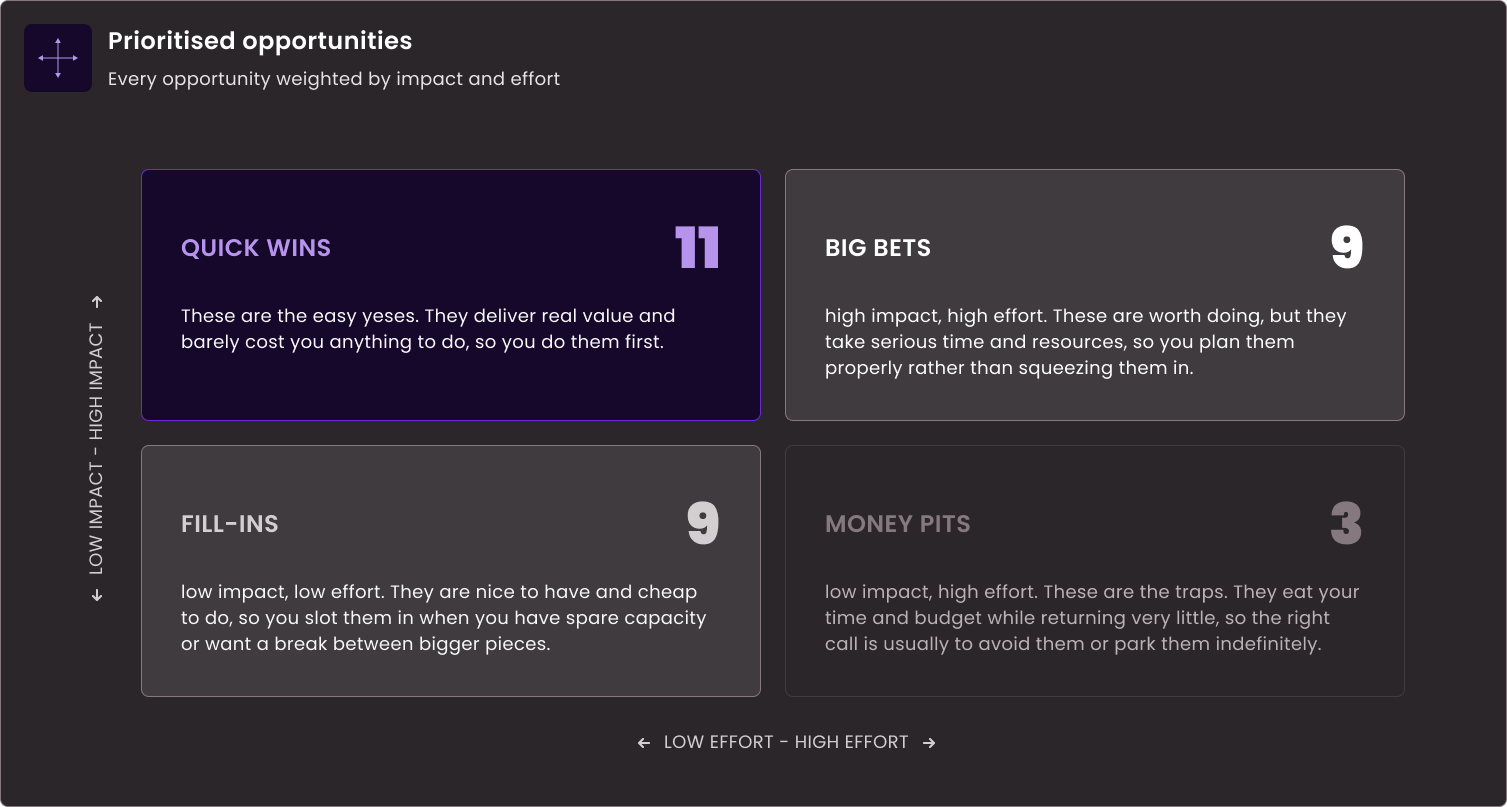
- I rank the opportunities by customer impact and high-level effort, then recommend two quick wins and three bigger projects to take forward to the solution stage.
week 3 – 5
Turn the roadmap into solutions
- I lead three 90-minute workshops with your team to turn the roadmap into practical onboarding changes.
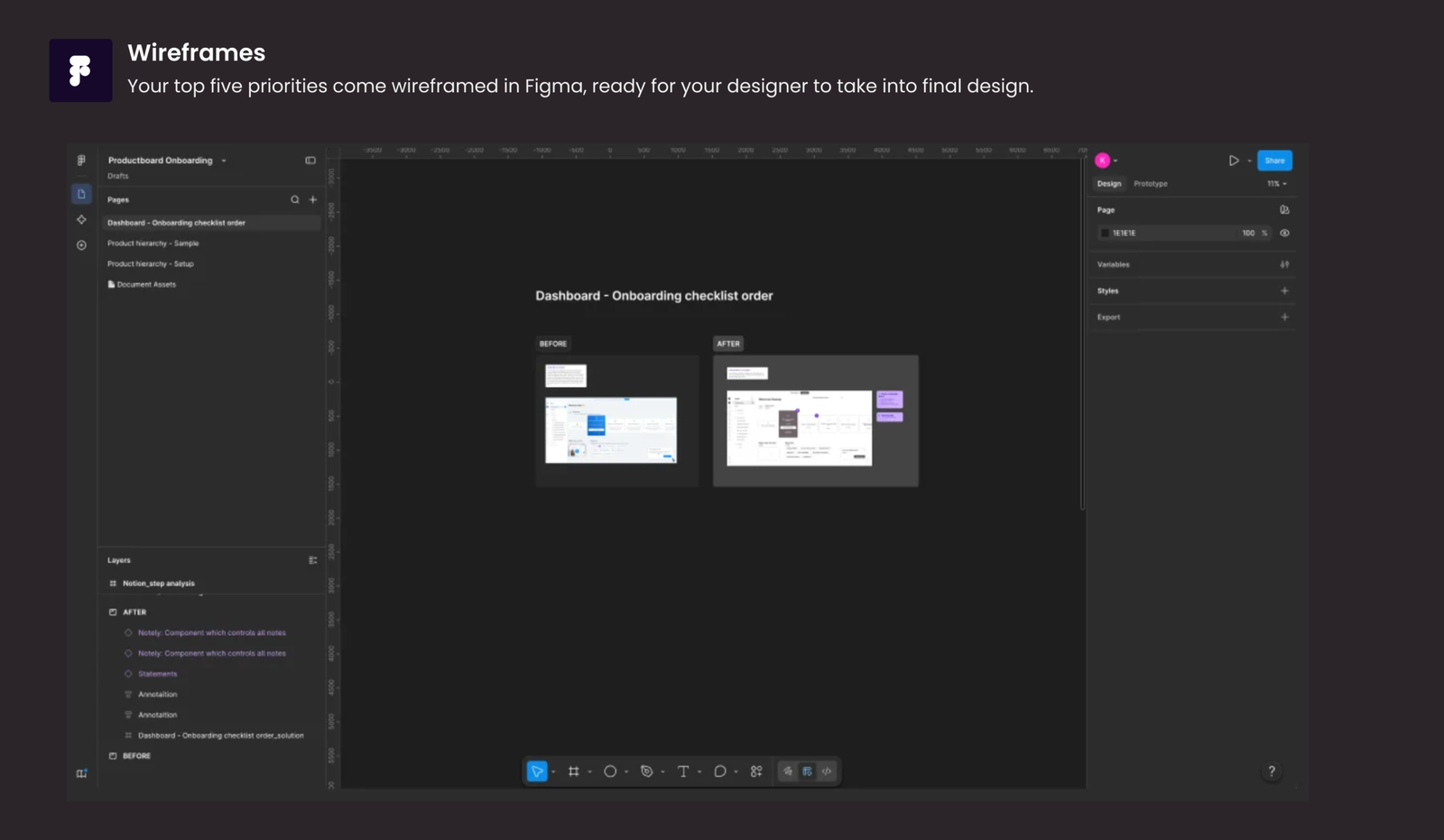
- You get five recommended solutions as annotated wireframes in Figma, ready for your product designer to turn into final designs.
THE FOLLOWING 30 DAYS
Support
- I stay involved async for 30 days after the wireframes are delivered.
- I follow up, answer questions and review designs, test plans and relevant findings.
—
About
Hi, I am Kate.
I am the founder of FounderUXLab.
I spent eight years as an Experience Designer, designing journeys for millions of users mainly in retail and automotive. Working in multi-disciplinary teams taught me how to move business metrics through functional design. My focus is on how people actually use a product, not just how the interface looks.
I only advocate for design improvements that are technically feasible and commercially sound. My goal is to find the minimum fix that solves the problem so your team can ship changes quickly.
The Sample audit page shows my thinking and the depth of my analysis. It is a transparent look at how I analyse an onboarding journey and turn those observations into a clear, actionable report. Take a look to see if my logic is a fit for your team.











—
Deliverables
The Onboarding Sprint includes
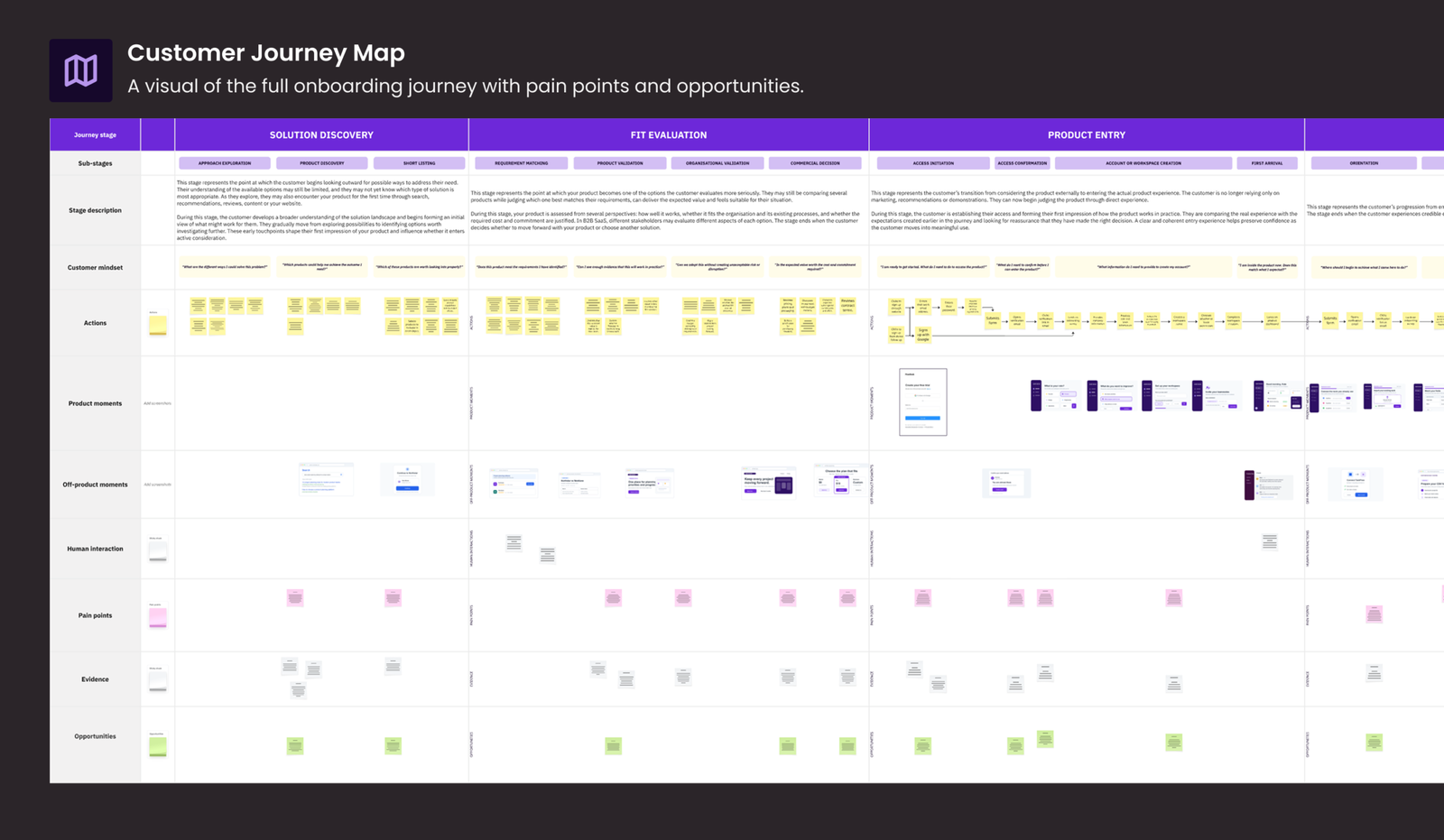
Customer Journey map
A visual of the full onboarding journey, showing how the stages connect and where pain points and opportunities appear.
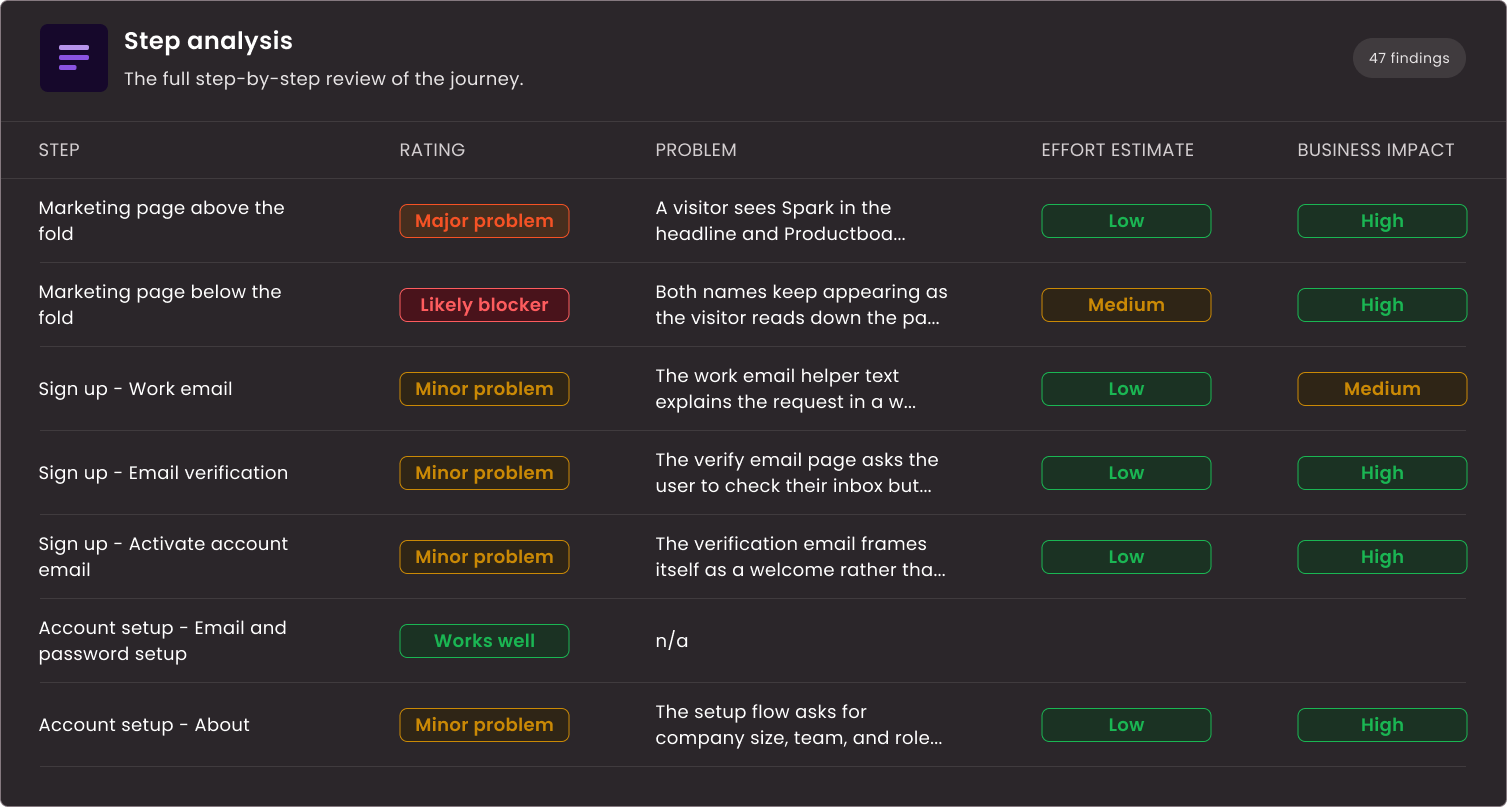
Step analysis
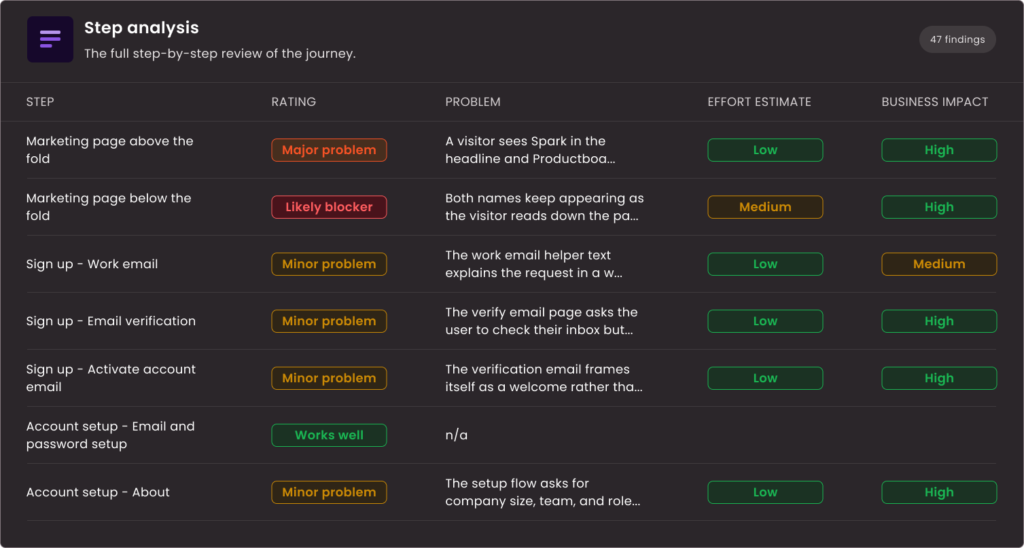
A detailed step-by-step review in Notion. Every step is rated, with an explanation of what works, what may stop users and why.
Every opportunity ranked by customer impact and high-level effort, so your team knows what to tackle first and what can wait.
Wireframed solutions
Five recommended changes wireframed and annotated in Figma, ready for your product designer to turn into final designs.
The Onboarding Sprint is for you if...
Your product is product-led.
Users can sign up and reach value on their own, without a demo or a sales call.
You've found product-market fit
You’ve seen users activate, stick around, or pay. Your product can create value. The problem is how many new users never get far enough to experience it.
You have evidence of an activation or early-retention problem.
Low activation rates. Drop-off at specific points in the journey. Support questions that keep surfacing the same confusion.
You can already see the problem. What you can’t see yet is the cause.
You can bring the right people into the Sprint, and act on what comes out of it.
WHAT HAPPENS NEXT
Start with a 40-minute intro call
Book the call
Pick a time that works for you and fill in a short form about your product, your users, and what you’re seeing in your onboarding. It helps me prepare before we talk.
The intro call
We discuss what is happening in your onboarding and whether the Sprint fits.
Receive the proposal
If it’s a fit, you’ll get a proposal with everything you need to decide. Talk it through with whoever needs to be involved, then come back with questions or a yes or no.
Contract and kickoff
If you decide to go ahead, I’ll send the contract and invoice. Once payment clears, the Sprint begins.
FAQ
What happens on the 40 minute intro call?
You’ll leave the call with two things:
- One concrete observation about your onboarding. Something specific I can see from reviewing your product before the call. Not a full audit, but one thing worth taking back to your team, whether you hire me or not.
- A clear answer on whether the Sprint fits your product. If it does, I’ll walk you through the next steps. If it doesn’t, I’ll tell you straight.
The call itself is a conversation. You walk me through your onboarding and what you’re seeing from your side. I ask questions. We work out whether it’s a fit together.
What should I bring to the intro call?
Three things make the conversation more useful:
Your onboarding data
Whatever you have on how new users move through your product. Activation rate, where users drop off, time-to-value, early churn numbers. Bring what you have. There is no minimum.
Your view of the user who's activating.
Who are they, what were they trying to solve, what do they have in common? If you don’t have this clearly defined, that’s fine. We’ll work with what you know.
What you've tried so far.
Any changes you’ve made to onboarding and whether they moved the numbers.
How long does the Sprint take from kickoff to delivery?
Allow around nine weeks from kickoff to the end of support. The Sprint is planned over five weeks, followed by 30 days of async implementation support.
The five-week timeline assumes your team can provide the necessary access and input, and attend the strategy session and workshops as scheduled. If these take longer, the Sprint timeline will move with them.
What's the investment for The Onboarding Sprint?
It is paid in two parts:
- $5,000 before kickoff
- $7,500 after the audit and priorities are delivered, before the Week 3 workshops begin
You can cancel within 48 hours of the first payment for a full refund. After 48 hours, the first payment is non-refundable.
Pricing is shown in USD. EU-based clients can be invoiced in EUR.
Do we need a clearly defined activation metric?
No.
I review what you currently track. The four hypotheses may point to a product behaviour that better represents the point where users first experience value.
Your team will still need to measure that behaviour over time and determine whether it leads to stronger retention.
What do you need from our team?
Choose one person to act as the project lead and my main contact. They help me get access to the product, research and data, and make sure the right people are available when their input is needed.
The team’s scheduled time includes one 45-minute strategy session and three 90-minute workshops. I may also send occasional questions between sessions.
Who do I need to involve from my team?
The Sprint works best when the people who hold the relevant knowledge contribute at the right points. You don’t need every role represented. One person often covers multiple perspectives. What matters is that the knowledge is there.
These are the perspectives I’ll need input from:
- Someone who knows your users directly. Customer support, customer success, product designer or researchers. They know what your users actually say, worry about, and get confused by.
- Someone who understands the current onboarding journey and product logic. Usually a product manager, product owner, or a founder who’s deep in product decisions. They can explain what the path is and why it works the way it does.
- Someone who will design the solutions. Product or UI designer. They’re the ones who will take the recommendations forward.
- Someone who understands business goals and urgency. Founder, sponsor, head of product, or growth lead. They hold the context on why this work matters now and what success looks like commercially.
- Someone who understands your measurement and data. Growth lead or analytics. They know what’s tracked, where drop-offs happen, and what the evidence actually shows.
- Someone who understands technical or operational constraints. Engineering lead or developer. They know what’s hard to change and what dependencies exist.
What is included in the 30 days of support?
You can send questions, designs, prototypes, testing plans and relevant findings for feedback.
Support is provided through email or Slack, with responses within two business days.
Calls, full UI design, development and code reviews are not included.
If you need ongoing support beyond 30 days, email kate@founderuxlab.com to discuss a monthly retainer.
Will you sign an NDA?
Yes. Send me your standard NDA before the intro call if you’d like it in place before we talk, or before kickoff if you’re comfortable with the intro call happening first.
Who won't benefit from the Sprint?
This Onboarding Sprint is not the right fit in four situations.
- Your onboarding involves a sales rep or implementation team getting users to value. The Sprint is built for self-serve products where users can sign up and reach value on their own.
- You don’t yet have users reaching value in your product. The Sprint finds where your onboarding is losing users before they experience the product working. If no one is reaching that point yet, the problem is upstream of onboarding.
- You don’t see a specific drop-off in early use. You don’t need perfect activation data. You do need reason to believe the problem is in those first few sessions.
- Your team can’t ship changes in the next quarter. The Sprint is only useful if someone builds the recommendations.
What if we are not ready for the Sprint after the intro call?
No pressure to move forward. You still leave with the observation I shared about your onboarding. That’s yours regardless of what we decide.
If things change later, the door’s open.
Have a question that is not answered here? Email kate@founderuxlab.com and I will get back to you.