

24 September 2026
|
4 min read
The Three Foundations of a SaaS Customer Journey Map
A good onboarding map needs a clear customer, a defined value experience, and something your team can track.
If your SaaS product works well for some customers but many don’t see its value, you might wonder why.
This question is trickier than it seems.
User onboarding should help customers recognise the value. However, the issue might be spread across different parts of the experience, not just one screen or interaction.
A customer journey map brings that experience into one view. The map can highlight where customers struggle and which areas need more focus.
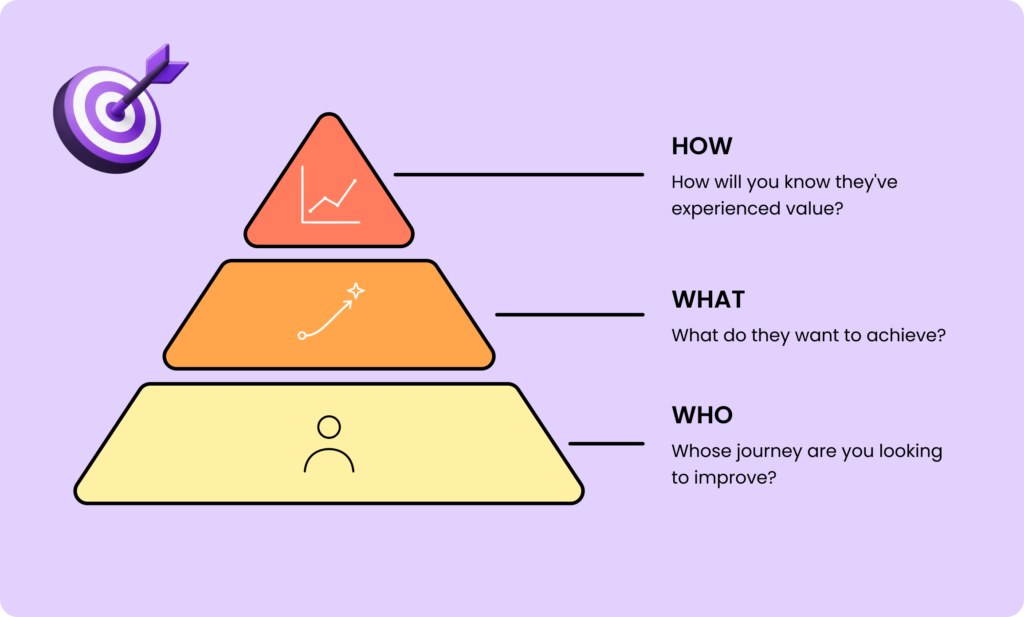
However, a helpful map relies on everyone being on the same page. Which means the whole team needs to agree on three things:
- The specific customer type the map will focus on.
- The outcome that customer type wants to achieve.
- The action or set of actions that would indicate they have likely experienced value.
Why alignment is crucial before mapping
Teams often rush past this alignment to get to the “real work” of mapping screens and drop-offs. They may end up with a map, but it won’t be useful.
Without agreement on the basics, the map lacks a clear focus.
Different customer types find value in different ways and may face different problems. Mixing different types on one map risks combining experiences that aren’t comparable.
If your product targets various customer types, each type requires a separate map designed for their goals.
The goal of this alignment is to clarify your assumptions and resolve any differences before deciding what needs to be fixed.
So, before you start mapping, write down clear answers to the following three questions and make sure everyone involved agrees.
WHO: Whose journey are you looking to improve?
WHO refers to the specific type of customer whose journey you want to understand and improve. Define them clearly enough that everyone knows who belongs on this map and who doesn’t.
To do this, you need to identify a group of customers who are in similar situations and are using your product to solve the same problem.
In B2B, that customer is often a team or account rather than one person. That’s because for many B2B products, value depends on several people adopting the product. In those cases, activation happens at the team level.
Your definition of this customer type should come from conversations with customers, not from assumptions about a “typical user.” It should reflect the problem they were trying to solve, how they dealt with it before your product, and what wasn’t working.
That context matters for two reasons:
- It tells you what your product needs to do differently.
- It also helps you write marketing language that reflects your customers actual struggle.
WHAT: What do they want to achieve?
Customers may appreciate your product and enjoy using it. But its value to them comes from what it helps them achieve. To understand what that value looks like, you need to define two outcomes.
- The larger outcome is the change the customer ultimately wants in their work or life. It gives you the bigger picture of what your product needs to help them achieve. You need this first because it determines what kind of early result would be meaningful to them.
- The smaller outcome is the first meaningful result the customer can experience during onboarding. It gives them real evidence that the product can help them reach the larger outcome. You may have heard this described as an “aha moment”.
Once both outcomes are clear, the final step is to identify how you’ll know if a customer has likely experienced value.
HOW: How will you know they've experienced value?
The WHAT describes value as a result the customer experiences. The HOW identifies the behaviour you can measure as evidence that the customer likely experienced that value.
Examples from well known products:
- Dropbox: Uploading the first file to a shared folder.
- Figma: Having two users edit the same file in real time.
- Zoom: Creating or joining the first video meeting link.
Experiencing value once does not necessarily mean the customer will continue using the product. That requires a separate measure that connects their early behaviour with retention.
These three ideas describe the progression:
- The smaller outcome: The first meaningful result the customer experiences during onboarding. It gives them evidence that the product can help them reach their larger outcome.
- The measurable evidence: The action or set of actions that indicates the customer has likely reached the smaller outcome.
- The activation milestone: A pattern of behaviour that your customer data links to higher retention. It often includes how many times an action happens and within what period.
You don’t need a fully validated activation milestone before improving onboarding. The measurable evidence provides a working measure while your teams can test how different frequencies and timeframes relate to retention. Once a pattern is consistently linked to stronger retention, it can define the activation milestone.
The mistake to avoid here
It’s tempting to assume that the answers to these three questions are obvious. Everyone on your team probably has an answer to each one. But those answers may differ slightly across marketing, product and customer success. Nobody notices until they’re well into the mapping process and disagree about which pain point is the real priority.
Writing all three answers down together forces any disagreement to happen early, when it’s cheap to resolve. Otherwise, it appears later as a debate about priorities, when the real problem is that the team never agreed on the foundations.
Where this fits into the bigger picture
WHO, WHAT and HOW are the foundation for everything that follows. Once they’re defined, you can map each action and route in the customer journey. Then you can add pain points, evidence and confidence levels to decide what is worth fixing first.
The accompanying video covers the full process, including how to map the journey stages and prioritise what to work on.